Aims :
- To be able to describe the characteristics of urban precipitation, surface and catchments.
- To recognise how the contrasts between urban and natural environments impacts on the water cycle including storage and transfers.
Tasks:
1. Graphically, describe the "Hillslope Water Cycle". Use the A 3 paper provided and work in pairs.
1. Graphically, describe the "Hillslope Water Cycle". Use the A 3 paper provided and work in pairs.
2. Again in pairs, list the ways in which Urban development is likely to impact on the Hill Slope Water Cycle. Be able to explain the differences.
Review... have you considered:
Inputs? (eg precipitation)
Stores? (eg channels, permanent stores, temporary stores, interception and soil storage)
Outputs? (eg discharge)
Task:
3. Make a brain storm diagram (or similar) to
a. categorise and b. describe the ways in which Urban Development alters natural water cycling. Refer to pp 154 in the core text to support.
How does urbanisation affect discharge?
The flood hydrograph -

Task:
4. Compare the two outline hydrographs provided. Describe the differences and attempt to explain what they suggest about the hydrology of the catchment they represent. Note, the differences are not necessarily related to urbanisation.
5. Complete the activities on pp 155 of the Human Core Text. Complete for HW if necessary.
CW 3rd March 2017
Title:
To understand the need for drainage management in urban areas.
To be able to describe, explain and evaluate Drainage Management techniques and systems.
Read pp 156 to 159.
Make notes as appropriate on the SUDs Lamb Drove.
Answer questions 1 and 2 on pp 159, plus the Stretch yourself activity and write a response to the "Think About" activity.
To complete by next lesson.
CW 6th March 2017
Title:
Answer the following questions (on paper for HI):
A. SUDs
1. What is a SUDs?
Feedback:
Responses are on the whole lacking detail and precision. This is an example of what I am looking for and how your understanding should be in evidence...
Sustainable Urban Drainage Management Systems or SUDs are schemes designed to replicate the processes in natural drainage systems that store, slow down transfers and cleanse water inputs to a catchment. These processes specifically relate to interception, infiltration, surface storage, groundwater storage and biological filtration of contaminants. In natural systems, the latter may be soil particles whereas in urban systems these will include chemicals, heavy metals as well as a range of particulates. In many traditionally designed urban areas, the impermeability and rapid flow characteristics of surfaces and drainage reduce storage and speed up transfers which can have negative impacts in terms of ground water stores and flooding as well as increasing the volume of pollutants entering drainage systems.
2. Name 3 techniques used in SUDs and explain how they work.
3. How effective are SUDs? Explain your view.
B. Lamb Drove - Case Study
1. Why is drainage management necessary at Cambourne?
2. Outline the techniques of drainage basin management employed at Lamb Drove, Cambourne?
3. What is meant by the term "management train"?
4. Why was the concept of the "management train" a key part of the SUDs at Lamb Drove?
5. DO SUDs reduce flooding?
CW 17th March 2017
Title:
5. With reference to Sheffield's "Blue Loop", outline the challenges to its successful and sustainable management.

4. Compare the two outline hydrographs provided. Describe the differences and attempt to explain what they suggest about the hydrology of the catchment they represent. Note, the differences are not necessarily related to urbanisation.
5. Complete the activities on pp 155 of the Human Core Text. Complete for HW if necessary.
CW 3rd March 2017
Title:
Drainage Management
To understand the need for drainage management in urban areas.
To be able to describe, explain and evaluate Drainage Management techniques and systems.
Read pp 156 to 159.
Make notes as appropriate on the SUDs Lamb Drove.
Answer questions 1 and 2 on pp 159, plus the Stretch yourself activity and write a response to the "Think About" activity.
To complete by next lesson.
CW 6th March 2017
Title:
Drainage Management - Review and consolidation.
Answer the following questions (on paper for HI):
A. SUDs
1. What is a SUDs?
Feedback:
Responses are on the whole lacking detail and precision. This is an example of what I am looking for and how your understanding should be in evidence...
Sustainable Urban Drainage Management Systems or SUDs are schemes designed to replicate the processes in natural drainage systems that store, slow down transfers and cleanse water inputs to a catchment. These processes specifically relate to interception, infiltration, surface storage, groundwater storage and biological filtration of contaminants. In natural systems, the latter may be soil particles whereas in urban systems these will include chemicals, heavy metals as well as a range of particulates. In many traditionally designed urban areas, the impermeability and rapid flow characteristics of surfaces and drainage reduce storage and speed up transfers which can have negative impacts in terms of ground water stores and flooding as well as increasing the volume of pollutants entering drainage systems.
2. Name 3 techniques used in SUDs and explain how they work.
3. How effective are SUDs? Explain your view.
B. Lamb Drove - Case Study
1. Why is drainage management necessary at Cambourne?
2. Outline the techniques of drainage basin management employed at Lamb Drove, Cambourne?
3. What is meant by the term "management train"?
4. Why was the concept of the "management train" a key part of the SUDs at Lamb Drove?
5. DO SUDs reduce flooding?
CW 17th March 2017
Title:
What is River Restoration?
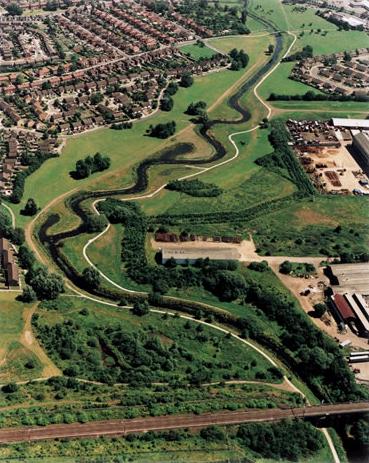 1. Describe the Geographical location of the R. Skerne.
4. Individually, assess the success of the scheme and its limitations in relation to the restoration of other urban sites.
Notes:
River restoration involves efforts to return a river that has been artificially altered to its natural state. If left alone, rivers will occasionally flood, but they are likely to be relatively small scale. The natural features of a river, such as meanders and wetlands, work to slow down river flow - reducing the likelihood of a major flood. River restoration projects often involve reconstruction of features like meanders to rivers that have been straightened.
Q. Why would rivers have been straightened.
Q. Hydrologically, what is the effect of restoring meanders?
The River Skerne in Darlington has been restored to create an attractive wetland environment by the River Restoration Centre as a demonstration project.
Activities:
1. Describe the Geographical location of the R. Skerne.
2. Explain why the R. Skerne was modified from its natural state.
3. Research (for presentation) how and why the river was returned to a more natural state. Include illustrations of the techniques and maps to show the changes.
5. With reference to Sheffield's "Blue Loop", outline the challenges to its successful and sustainable management.

Completion of non-presentation questions by Mondays session. Use Monday to finish/polish task 3 (presentation) - ready to go on Thursday.
Sheffield city centre's Blue Loop

No comments:
Post a Comment
Note: only a member of this blog may post a comment.